

The “Pins and Needles” Mystery: Why do my Arms and Hands Go Numb at Night
It’s 3:00 AM. You wake up with a jolt, but not because of a loud noise or a bad dream. Instead, you have the strange, unsettling sensation that your arm no longer belongs to you. It feels like a heavy “bag of sand” attached to your shoulder. As you try to move it, a prickly, buzzing sensation—the classic “pins and needles”—begins to swarm through your fingertips.
You spend the next two minutes frantically shaking your hand, waiting for the “fuzziness” to fade so you can finally drift back to sleep.
If this sounds familiar, you are part of a massive group of people who deal with nighttime numbness. It’s a jarring experience that often leads to a frantic late-night Google search. Many people immediately worry about their heart or assume they have “bad circulation.”
However, for the vast majority of healthy adults, waking up with a “dead arm” isn’t a sign of a clogged pipe; it’s a mechanical signal from your nerves. It’s your body’s way of telling you that your current sleep setup is accidentally pressing the “mute” button on your internal wiring.
If you’re wondering why your arms go numb while you sleep, the good news is that once you understand the mechanics of why this happens, it becomes much easier to fix.
Waking up with a “dead arm” or tingling hands?
Take our free Sleep Assessment Quiz to uncover the hidden sleep habits that may be putting unnecessary pressure on your shoulders, neck, and nerves while you rest.
Is It Circulation or Nerves? Understanding the “Dead Arm”
IWhen we feel that tingling sensation, our first instinct is to think about blood flow. We’ve all heard the phrase “you’re cutting off your circulation.” But in the world of sleep mechanics, the culprit is usually your nervous system.
The “Electrician” Analogy
To understand this, think of your arm like a bedside lamp. For the lamp to stay lit, it needs a constant flow of electricity through its power cord. If you place the heavy leg of a chair on top of that cord, the light might flicker or go out entirely.
Your nerves are that power cord. They carry “electricity” (signals) from your brain to your hands. When you sleep in a position that puts prolonged pressure on these nerves, the signal gets interrupted. The “pins and needles” feeling is actually the “reboot” process—the sensation of those electrical signals rushing back into the limb once the pressure is removed.
The Main Cable: A Quick Look at the Brachial Plexus
Most of the numbness we feel in our arms during sleep originates in a specific area called the Brachial Plexus.
Don’t let the technical name intimidate you. Think of the Brachial Plexus as the “main electrical hub” for your arm. It is a dense bundle of nerves that exits your neck and travels through a narrow gap between your collarbone and your first rib, eventually heading down into your shoulder and arm.
Because this hub is located right at the intersection of your neck and shoulder, it is incredibly susceptible to pressure when you are lying horizontal for seven or eight hours. If your head and shoulders aren’t perfectly aligned, you end up “pinching the cord” at the source.

Most People Blame Circulation. They’re Looking in the Wrong Place.
When an arm “falls asleep,” many people immediately assume poor circulation is the problem.
But in many cases, the real issue may be related to how the neck, shoulder, and arm are positioned for hours during sleep.
Small alignment issues can place pressure on nerve pathways, leading to the familiar “pins and needles” sensation that disappears once the position changes.
How Side Sleeping Can Increase Shoulder Pressure
Side-sleeping is the most popular position in the United States, and for good reason—it’s generally great for breathing and digestion. However, if your pillow isn’t doing its job, side-sleeping can turn your shoulder into a “kickstand” for your entire upper body.
When Your Shoulder Becomes a Kickstand
When you lie on your side, your bottom shoulder has to go somewhere. Ideally, it should rest comfortably in a position that keeps your spine straight. But if your pillow is too flat or has lost its structural integrity, the weight of your torso collapses onto that shoulder.
This “shoulder crush” puts direct, sustained pressure on that Brachial Plexus nerve hub. It’s like sleeping with a heavy weight resting right on your “power cord.” This is why you might wake up with numbness only on the side you were sleeping on.
Why “Soft” Isn’t Always “Supportive”
Many people choose pillows based on how “cloud-like” they feel in the store. But a pillow that is too soft often fails to provide the height needed to fill the gap between your ear and the mattress.
When that gap isn’t filled, your head tilts down toward the bed. This tilt compresses the nerves on one side of your neck and overstretches them on the other. This mechanical “crowding” is the primary trigger for nighttime tingling.
Interestingly, this is the same mechanical failure that leads to a “crick” in the neck. If you find that your numbness is often accompanied by a stiff neck, you’re likely dealing with a dual issue of poor alignment. You can read more about how this tilt affects your spine in our guide on Why Do I Wake Up With Neck Pain Every Morning?.
The Neck-Shoulder Tension Loop
Sometimes, the “dead arm” isn’t just about how you’re lying; it’s about the state of your muscles before you even get into bed.
How Tight Muscles “Crowd” the Pathway
In our modern world, most of us spend our days hunched over computers, steering wheels, or smartphones. This posture causes the muscles in the front of our necks and chests to “shorten” and tighten.
When these muscles are chronically tight, they physically narrow the space that the Brachial Plexus nerves have to travel through. It’s like trying to run a power cord through a pipe that is already half-full of debris. By the time you lie down, your nerves are already “crowded.” It takes very little additional pressure from a bad pillow to “trip the circuit” and cause your hand to go numb.
Why This Makes You Wake Up Tired
The most frustrating part of nighttime numbness isn’t just the tingling; it’s the disruption to your sleep cycle. Your brain is incredibly protective of your nervous system. The moment it detects that a nerve is being compressed, it triggers a “micro-arousal.”
You might not fully wake up, but your brain pulls you out of deep, restorative sleep so that you will shift your weight and “un-pinch” the nerve. If this happens five, ten, or twenty times a night, you will wake up feeling exhausted, even if you “slept” for eight hours. This constant “repositioning” is a major, often-overlooked factor in chronic fatigue. If you feel like you’ve slept a full night but still feel like you’re running on empty, you might want to explore the reasons Why You Wake Up Tired Even After Sleeping All Night.
Did You Know?
Many people assume nighttime numbness is always caused by poor circulation.
However, sleep posture, shoulder pressure, and head-to-neck alignment may also influence how comfortable your arms and hands feel during the night.
That's one reason why paying attention to sleep mechanics can sometimes reveal patterns that would otherwise go unnoticed.
Many people assume nighttime numbness is always caused by poor circulation.
However, sleep posture, shoulder pressure, and head-to-neck alignment may also influence how comfortable your arms and hands feel during the night.
That’s one reason why paying attention to sleep mechanics can sometimes reveal patterns that would otherwise go unnoticed.

Self-Assessment: Are Your Sleep Habits Affecting Your Nerves?
Before you can fix the problem, you need to identify your patterns. Take a moment to think about your typical morning and night. If you answer “yes” to more than two of these, your sleep mechanics are likely the culprit:
- The Hand-Tuck: Do you often wake up with your hand or arm tucked directly under your head or your pillow?
- The Side-Switch: Do you find yourself flipping from left to right multiple times because one arm “gets uncomfortable”?
- The Quick Fade: Does the numbness usually vanish within 60 seconds of sitting up and moving around?
- The Shoulder Shrug: Do you feel like you have to “shrug” or hike your shoulders up to feel comfortable when you first lie down?
- The Pillow Collapse: Does your pillow feel great when you first go to bed, but feel like a “pancake” by 4:00 AM?
Do any of these sleep habits sound familiar?
Small posture and alignment issues can sometimes create unnecessary pressure on the shoulders, neck, and arms during the night.
Take our free Sleep Assessment to identify patterns that may be affecting your comfort while you sleep
.
Immediate Fixes: 3 Practical Tips for Tonight
You don’t have to wait to start improving your nerve health. Here are two practical adjustments you can try tonight to open up those nerve pathways.
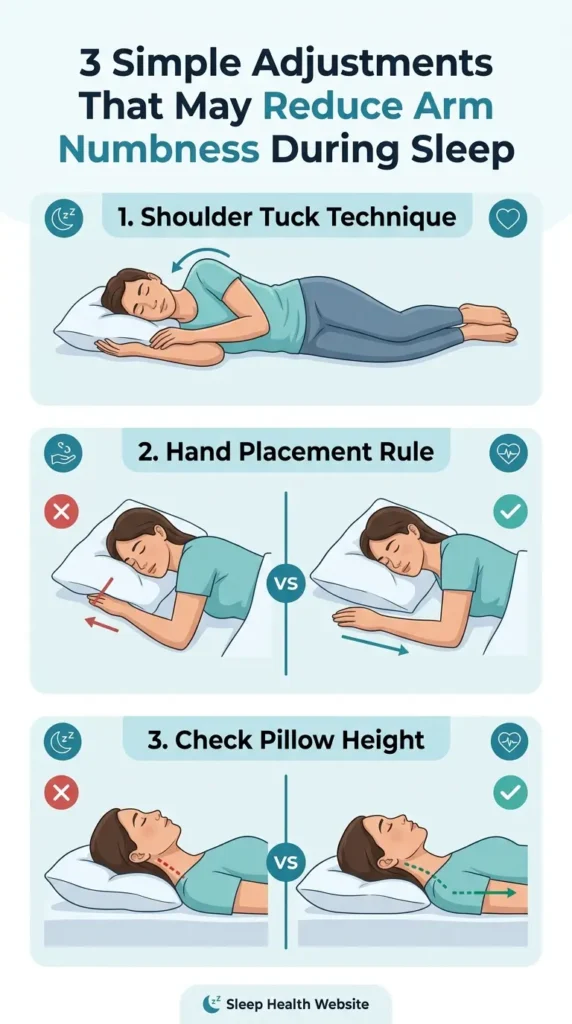
Tip 1: The “Shoulder Tuck” Technique
Most side-sleepers lie directly on the “point” of their shoulder, which drives the bone upward into the nerve hub. Instead, try the Shoulder Tuck.
When you lie down, roll your bottom shoulder slightly forward (toward the front of your body) so that you are resting on the back of your shoulder blade rather than the point of the shoulder. This small shift creates a “natural channel” for the nerves and reduces direct pressure on the Brachial Plexus.
Tip 2: The Hand-Placement Rule
Many of us subconsciously reach upward when we sleep, placing our hands over our heads or under our pillows. This position is called “hyper-abduction,” and it puts your nerves on a significant stretch.
Try to keep your hands below the level of your heart. If you need something to hold onto, hug a small “cuddle pillow” or a body pillow. This keeps your arms in a neutral, relaxed position and prevents the nerves from being stretched like a tightrope.
Tip 3: Check Your Pillow Height
When lying on your side, your head should remain aligned with your spine rather than tilting toward the mattress.
If your head drops downward, your pillow may not be providing enough support.
What Science Suggests About Proper Support
If you’ve tried the tips above and still find yourself waking up with “pins and needles,” it might be time to look at the tools you’re using. Sleep science has come a long way in understanding how to protect the nervous system during rest.
Creating a “Relief Channel” for Your Shoulders
The most effective orthopedic designs today focus on creating a “relief channel.” This is a structural feature that allows the head to be supported at the correct height while providing a dedicated “landing zone” for the shoulder.
When the head is supported and the shoulder has a place to go, the pressure on the Brachial Plexus vanishes. It’s the difference between your shoulder being an “anchor” and your shoulder being “nested.”
The Role of Memory Foam in Pressure Distribution
Standard pillows create “pressure points” because they don’t distribute weight evenly. High-density materials, like modern memory foams, work differently. They react to the heat and weight of your body to “melt” away pressure. By distributing the weight of your head across a larger surface area, these materials ensure that no single nerve or muscle is forced to bear the brunt of the load.
Frequently Asked Questions
“Why do my fingers tingle even if I sleep on my back?“
Back sleepers aren’t immune to numbness. If your pillow is too high, it pushes your head forward (chin-to-chest), which can compress the nerves as they exit the cervical spine. If you’re a back sleeper, you want a pillow that supports the curve of your neck while letting your head sit level.
“Is it normal for the numbness to happen every night?”
While occasional numbness from a “funky” position is normal, experiencing it every night is a clear signal from your body that your alignment is off. It’s not something you have to “just live with.”
“Can my mattress be the problem?”
Yes. If your mattress is extremely firm, it won’t allow your shoulder to “sink in” at all. This forces the shoulder up toward the ear, even if you have a great pillow. A mattress should have enough “give” to accommodate the widest parts of your body (hips and shoulders).
Conclusion: Listening to Your Body’s “Signals”

Waking up with “pins and needles” can be annoying and even a little scary, but it’s actually a brilliant safety feature of your body. Those sensations are just your nerves’ way of sending a mechanical signal that your alignment is off.
You wouldn’t ignore a check-engine light in your car, and you shouldn’t ignore a “dead arm” in your bed. By making small shifts in your posture, keeping your hands in a neutral position, and ensuring your head and shoulders are properly supported, you can stop the 3:00 AM “shaking out” routine for good.
Every body is built differently—what works for a back sleeper with a narrow frame might not help someone who sleeps on their side with broad shoulders. The key is finding where your specific “alignment gap” is located.
What to Remember:
- Arm numbness during sleep is often related to nerve pressure rather than poor circulation.
- Side sleeping can sometimes increase shoulder pressure and affect nerve pathways.
- Pillow height and head-to-neck alignment may influence nighttime comfort.
- Sleeping with your hand under your head can increase the likelihood of tingling sensations.
- Small adjustments to sleep posture may help reduce overnight discomfort and interruptions.
Wondering whether your sleep position may be contributing to nighttime numbness?
Every body is different. The habits, positions, and support that work for one sleeper may not work for another.
Our Sleep Assessment can help you identify patterns that may be affecting your comfort, posture, and overall sleep quality.
Sources
This article was created using information from peer-reviewed scientific studies and reputable health organizations.
• Sleep Foundation – Side Sleeping and Sleep Posture
• National Institutes of Health (NIH) – Peripheral Nerve Compression and Sleep
• Cleveland Clinic – Causes of Numbness and Tingling in the Arms
• Healthcare Journal – Pillow Design, Pressure Distribution and Sleep Comfort
• Research on Sleep Posture, Shoulder Pressure and Musculoskeletal Health
Enjoyed this article?
If you found this guide helpful, consider sharing it with someone who may also benefit from healthier sleep habits.