It’s 7:00 AM. Your alarm goes off, and before you even open your eyes, you feel it. Your mouth feels like a desert—parched, sticky, and completely devoid of moisture. You reach for the glass of water on your nightstand, but even after a few gulps, that scratchy, “sandpaper” feeling in your throat lingers.
Most people assume that waking up with a dry mouth is simply a sign that they didn’t drink enough water before bed. Others believe that snoring and morning fatigue are just the inevitable “taxes” we pay for getting older. But what if the “thirst” you feel every morning isn’t about hydration at all?
What if the primary culprit behind your dry mouth, snoring, and unrefreshing sleep is actually a mechanical issue happening while you dream?
Science suggests that the way we position our heads, necks, and jaws during sleep can fundamentally change how we breathe. When our “sleep setup” fails to support our anatomy, gravity takes over, airflow becomes less efficient, and our bodies are forced to find ways to compensate.
In this article, we’re going to look past the water glass and explore the fascinating mechanics of sleep posture. We’ll discover how a simple “kink” in your airway alignment can lead to mouth breathing, snoring, and that frustrating morning “desert mouth.”
Not sure if your sleep position may be affecting your breathing?
Take our free Sleep Assessment Quiz to discover how your sleep habits, posture, and nighttime patterns may be influencing your sleep quality.
The Hidden Connection Between Dry Mouth and Sleep Position
The medical term for dry mouth is xerostomia, but in the context of sleep, it is almost always the result of a very specific habit: mouth breathing.
Saliva is your mouth’s natural defense system. It keeps tissues moist, neutralizes acids, and helps wash away bacteria. Under normal circumstances, you breathe through your nose while you sleep. The nose acts as a sophisticated filtration and humidification system, warming the air and keeping the moisture where it belongs—inside your body.
However, when you breathe through your mouth, you bypass this system. The constant flow of air over your tongue, palate, and throat acts like a high-speed fan, evaporating your saliva at an incredible rate. By the time morning rolls around, your tissues are dehydrated, leading to that sticky, parched sensation.
Why Does Your Mouth Open in the First Place?
This is where sleep position comes into play. If you are a back sleeper, you are fighting a constant battle with gravity.
Think about the weight of your jaw. When you are upright during the day, your muscles easily hold your jaw closed. But when you lie on your back and enter deep sleep, your muscles reach a state of total relaxation. Without proper support, gravity pulls your lower jaw (the mandible) downward toward your neck.
As the jaw drops, the lips naturally part. Once the seal of the mouth is broken, the body often switches to mouth breathing as a path of least resistance. This is why many people find that they only experience dry mouth when they sleep on their backs, but feel slightly better when they manage to stay on their sides.
Did You Know?

Many people assume waking up with a dry mouth simply means they didn't drink enough water before bed.

However, sleep posture, jaw position, airway alignment, and mouth breathing may also play an important role in how hydrated your mouth feels when you wake up.

That's one reason why looking beyond hydration and paying attention to sleep mechanics can sometimes reveal patterns that would otherwise go unnoticed.
Why Snoring Often Starts With Airflow Changes
If dry mouth is the “quiet” symptom of poor sleep mechanics, snoring is the “loud” one.
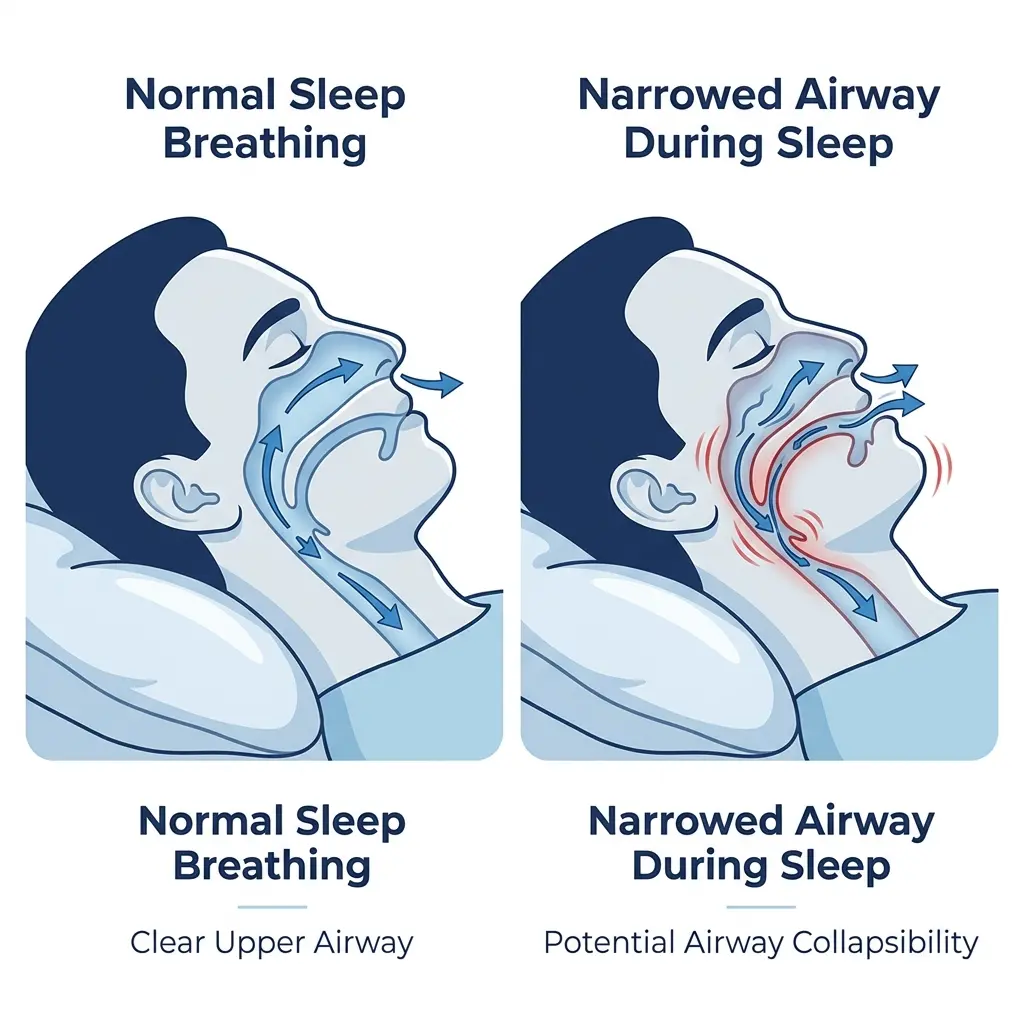
To understand snoring, we have to look at the geometry of the throat. Your airway is a flexible tube made of muscle and soft tissue. When you are awake, the tone of these muscles keeps the tube wide open. But as you drift into sleep, those tissues become soft and relaxed.
If your sleep position allows your airway to narrow—even by just a few millimeters—the air you breathe has to move faster to get into your lungs. This fast-moving air creates turbulence, causing the soft tissues in your throat (like the soft palate and uvula) to vibrate. That vibration is the sound we call snoring.
Why These Symptoms Often Appear Together – Snoring and Dry Mouth.
Snoring and dry mouth are often two sides of the same coin. Here is how the mechanical chain reaction usually works:
Alignment Fails: Your head is tilted at an awkward angle, or your jaw isn’t supported.
The Pathway Narrows: Gravity pulls the tongue and jaw back, narrowing the space for air.
The Body Switches Gears: Because it’s harder to get air through the nose, the mouth drops open to pull in more volume.
Turbulence Occurs: The air rushing through the open mouth and narrowed throat creates the vibrations of snoring.
Evaporation Begins: The constant air movement dries out the throat and mouth.
This is why people who snore almost always wake up with a parched throat. It isn’t just about the “noise”; it’s about the physical stress being placed on the tissues as they struggle to maintain efficient airflow.
The Airway Gap: How Head and Neck Position May Affect Breathing During Sleep
One of the most powerful ways to understand sleep mechanics is the Garden Hose Analogy.
Imagine you are out in the yard, watering the garden. As long as the hose is straight, the water flows with full pressure. But what happens if you put a kink in the hose? The water flow drops to a trickle. To get the water through, you’d have to turn up the pressure at the source, and the hose might start to vibrate or hiss under the strain.
Your airway functions in a remarkably similar way.
When Your Head Tilts Too Far Forward
Many modern pillows are designed for “plushness” rather than “alignment.” If your pillow is too thick, it can push your head forward, tucking your chin toward your chest.
In this “chin-tuck” position, you are essentially putting a kink in your garden hose. The tissues at the front of your neck are compressed, and the space behind the tongue is reduced. To compensate, your body often forces your mouth open to try and bypass the restriction.
When Your Head Tilts Too Far Back
Conversely, if your pillow is too flat or non-supportive, your head may tilt too far backward. This can cause the muscles in the front of the neck to stretch tight, which pulls on the jaw and—you guessed it—pulls the mouth open.
For the air to flow freely, your head and neck need to be in a “neutral” position. This usually means a slight, natural elevation (around a 30-degree angle for many people) that keeps the chin away from the chest without overextending the neck.
When you find this “sweet spot,” your jaw is more likely to remain in a natural, closed position, and the “tube” of your airway remains at its widest possible diameter. This reduces the need for the mouth to drop open and decreases the turbulence that leads to snoring.
Signs Your Sleep Setup May Be Affecting Your Airway
How do you know if your morning dry mouth is a result of your sleep posture? Sometimes the signs are subtle, but they are almost always there if you know what to look for.
These small clues often go unnoticed, but together they can reveal a lot about what may be happening during the night. If you recognize these patterns, your pillow or sleep position may be the silent culprit.
Many people assume nighttime numbness is always caused by poor circulation.
However, sleep posture, shoulder pressure, and head-to-neck alignment may also influence how comfortable your arms and hands feel during the night.
That’s one reason why paying attention to sleep mechanics can sometimes reveal patterns that would otherwise go unnoticed.
The Morning Mechanical Checklist
The “Desert Mouth”: You wake up feeling like you need to drink a gallon of water immediately.
The Scratchy Throat: You don’t feel “sick,” but your throat feels raw or irritated for the first hour of the day.
The “Pillow Fight”: You wake up with your arm tucked under your pillow, or you’ve pushed the pillow into a specific bunch to feel comfortable. Some people also notice that sleeping with an arm trapped under the pillow or body can create pressure on the shoulder and upper arm during the night. In certain cases, this may contribute to numbness, tingling, or discomfort that becomes noticeable after waking up.
The Midday Fog: Even after a full night’s sleep, you feel a lingering fatigue, as if your body didn’t quite get the “deep” rest it needed.
The Partner Report: You’ve been told you snore, but only when you are in certain positions (like on your back).
The Nightstand Water Glass: You find yourself waking up multiple times just to take a sip of water because your mouth feels uncomfortably dry.
Many people assume nighttime numbness is always caused by poor circulation.
However, sleep posture, shoulder pressure, and head-to-neck alignment may also influence how comfortable your arms and hands feel during the night.
That’s one reason why paying attention to sleep mechanics can sometimes reveal patterns that would otherwise go unnoticed.
Why Dry Mouth May Be Affecting Your Sleep Quality
If you are waking up to drink water, you are breaking your sleep cycle. Each sip of water represents a “micro-awakening.” You might not remember these fully the next morning, but they prevent you from staying in the deep, restorative stages of sleep.
In this way, dry mouth isn’t just an annoyance; it’s a direct thief of your energy and long-term wellness. By addressing the mechanical reason your mouth is drying out, you aren’t just fixing a “thirsty throat”—you are protecting your sleep cycle.
Simple Sleep Adjustments That May Support Better Airflow
The goal of improving your sleep mechanics is to make it as easy as possible for your body to breathe through your nose. While everyone’s anatomy is different, there are several “gravity-defying” adjustments you can try tonight to support a clearer airway and a moister mouth.
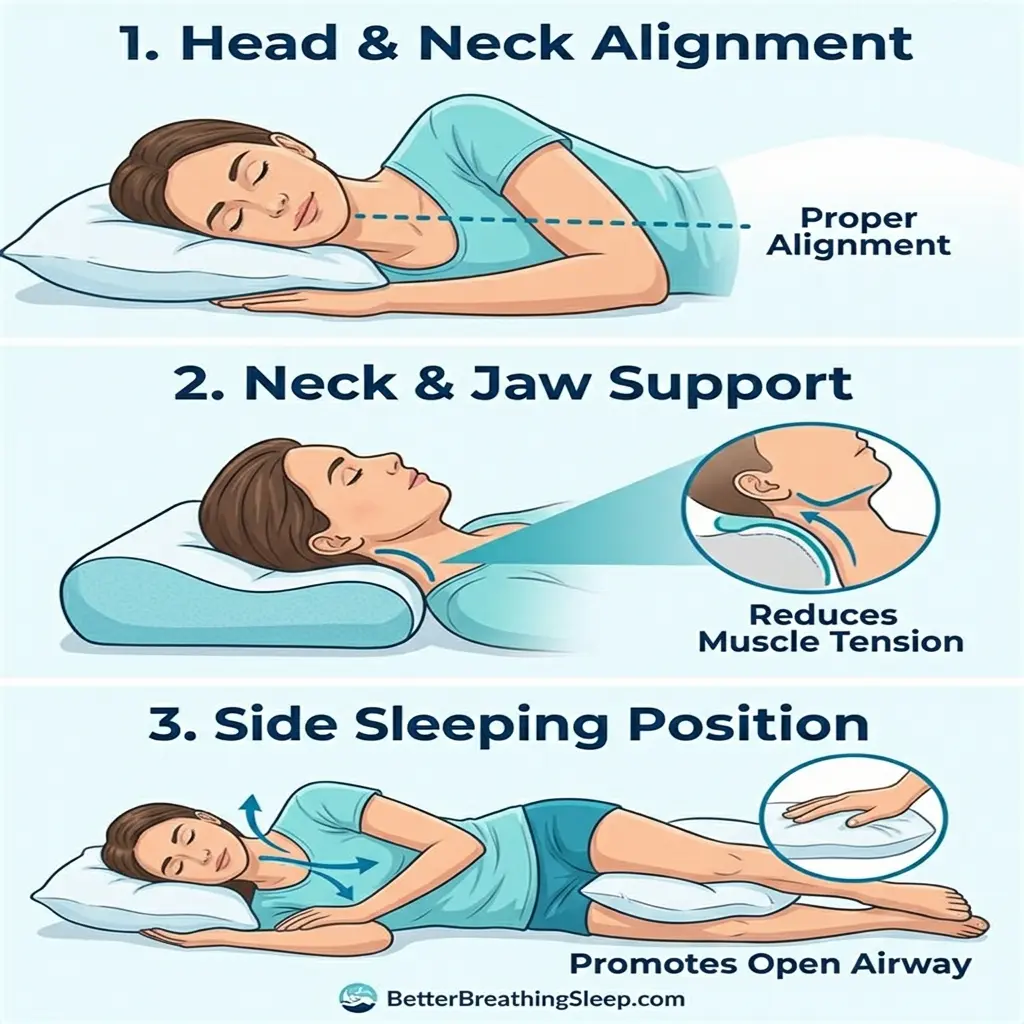
1. Optimize Your Head Angle
As we discussed with the garden hose analogy, the angle of your head is everything. Try to find a setup that keeps your chin in a “neutral” position.
Try to find a support system that keeps your head level with your spine while providing a slight cradle for the base of the skull.
The Test: If you lie down and feel your chin touching your chest, your head is too high.
The Test: If you feel like your throat is being “stretched” and your chin is pointing at the ceiling, your head is too low.
Try to find a support system that keeps your head level with your spine while providing a slight cradle for the base of the skull.
2. Support the Jaw, Not Just the Head
Most people think a pillow is for the head, but for airway comfort, it’s actually for the neck and jaw.
Look for a sleep setup that fills the “gap” under your neck. When the neck is supported, the muscles in the jaw are less likely to experience the tension that pulls the mouth open.
By supporting the base of the jaw, you provide a “shelf” that helps counteract the pull of gravity.
3. Consider Your Primary Position
If you are a back sleeper struggling with dry mouth, gravity is your biggest opponent.
Side Sleeping: Transitioning to side sleeping can be one of the most effective ways to keep the airway open, as it prevents the tongue from falling straight back.
The “High-Back” Position: If you must sleep on your back, try to elevate your upper torso and head slightly using a wedge or a more structured support system. This uses gravity to your advantage, keeping the jaw more stable.
Every person sleeps differently.
A position that works well for one person may create unnecessary strain for someone else. Our free Sleep Assessment can help you identify patterns that may be affecting your comfort, breathing, and sleep quality.
While mechanics are the primary focus, the environment matters too.
If your bedroom air is very dry (especially in the winter), even a small amount of mouth breathing will be amplified.
Keep your bedroom cool and consider a humidifier to take the “edge” off the air, which can buy your tissues a little more time before they dry out.
A Better Understanding of Morning Dry Mouth
Waking up with a dry mouth, a scratchy throat, or the lingering shame of snoring isn’t something you simply have to “live with.” It’s a signal—a mechanical message from your body that your airway is struggling to find the path of least resistance.
When we realize that sleep is a physical, mechanical process, we gain the power to improve it. It’s about more than just “getting enough hours.” It’s about the quality of the airflow moving through that “garden hose” for one-third of your life.
By understanding the relationship between gravity, jaw position, and head alignment, you can move away from the frustration of “desert mouth” and toward a morning where you wake up feeling truly hydrated and refreshed. Small adjustments to your sleep setup aren’t just about comfort; they are about giving your body the “green light” to breathe, rest, and recover exactly the way nature intended.
1. Why is my mouth dry even if I drink plenty of water?
Because morning dry mouth is usually caused by mouth breathing, not a lack of internal hydration. If you breathe through your mouth all night, you are physically evaporating the saliva. You can be the most hydrated person in the world, but if your mouth is open, those tissues will still dry out.
2. Does snoring always mean my airway is blocked?
Not necessarily “blocked,” but it usually means the pathway is narrowed. Think of it like a whistling tea kettle; the sound happens because air is being forced through a smaller opening. Snoring is a sign that your body is working harder than it should have to for each breath.
3. Can a pillow really help with snoring?
A pillow’s job is to manage the “geometry” of your neck and head. If a pillow helps keep your chin away from your chest and supports your jaw so it doesn’t drop open, it can significantly reduce the turbulence that causes snoring.
4. Why do I only wake up with a dry mouth when I sleep on my back?
Gravity. When you are on your back, your jaw and tongue have no choice but to fall backward toward your throat. On your side, the “weight” of these structures falls to the side of the mouth, which often keeps the central airway clearer and the mouth more easily closed.
5. How can I tell if I’m breathing through my mouth at night?
The biggest clue is how you feel the moment you wake up. If you have a dry mouth, “sticky” teeth, or a sore throat that disappears after you drink water or brush your teeth, you were almost certainly mouth breathing. Another sign is waking up with “crusty” lips or feeling excessively thirsty in the middle of the night.
What to Remember: The Morning Dry Mouth Mystery
Mechanical Thirst: Dry mouth is often caused by mouth breathing, which evaporates saliva faster than your body can produce it.
The Gravity Trap: When we sleep on our backs, gravity pulls the jaw and tongue backward, which can narrow the airway and force the mouth to open.
The Garden Hose Effect: If your head is tilted too far forward or backward due to poor pillow support, your airway can become restricted, much like a bent garden hose.
The Vibration of Snoring: Snoring is often the sound of air struggling to pass through a narrowed pathway; it’s a mechanical signal that your alignment may be off.
Small Changes, Big Impact: Adjusting your head angle and supporting your jaw can help maintain a natural, closed-mouth breathing pattern throughout the night
Morning dry mouth, snoring, and restless sleep may share the same underlying patterns.
Discover how your sleep posture, breathing habits, and nighttime routines may be affecting your sleep quality.
This article was created using information from peer-reviewed scientific studies and reputable health organizations.
• Sleep Foundation – Mouth Breathing During
• Sleep Sleep Foundation – Sleeping Positions
• Cleveland Clinic – Dry Mouth (Xerostomia)
• Cleveland Clinic – Snoring
• Mayo Clinic – Dry Mouth
• NIH studies on sleep breathing and airway mechanics
Enjoyed this article?
If you found this guide helpful, consider sharing it with someone who may also benefit from healthier sleep habits.
Manage Consent
To provide the best experiences, we use technologies like cookies to store and/or access device information. Consenting to these technologies will allow us to process data such as browsing behavior or unique IDs on this site. Not consenting or withdrawing consent, may adversely affect certain features and functions.
Functional
Always active
The technical storage or access is strictly necessary for the legitimate purpose of enabling the use of a specific service explicitly requested by the subscriber or user, or for the sole purpose of carrying out the transmission of a communication over an electronic communications network.
Preferências
O armazenamento ou acesso técnico é necessário para o objetivo legítimo de armazenar preferências que não são solicitadas pelo assinante ou usuário.
Statistics
The technical storage or access that is used exclusively for statistical purposes.O armazenamento ou acesso técnico que é usado exclusivamente para fins de estatísticas anônimas. Sem uma intimação, conformidade voluntária do seu provedor de serviços de internet ou registros adicionais de terceiros, as informações armazenadas ou coletadas apenas com esse objetivo geralmente não podem ser usadas para identificar você.
Marketing
The technical storage or access is required to create user profiles to send advertising, or to track the user on a website or across several websites for similar marketing purposes.